Bursa
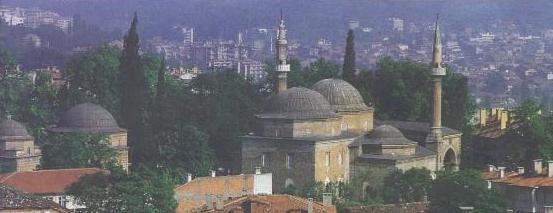
Muradiye Complex
|
The city of Bursa, southeast of the Sea of Marmara, lies on the lower slopes of Uludag (Mt. Olympos of Mysia, 2443 meters). The city derives its name from its founder Prusias, King of Bithynia.It subsequently came under Roman, then Byzantine rule before falling to Osman Bey in 1326 becoming the first capital of the Ottoman Empire.Many important Ottoman buildings remain.
|
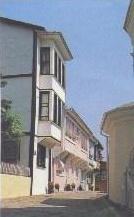
Osman Gazi Street
|
Known as "Green Bursa", the city ,is filed with gardens and parks and overlooks a verdant plain. It is at the center of an important fruit growing region. Bursa was, and is still, famous for its silk trade,towel manufacture and thermal springs. You must taste locally invented Iskender Kebab, a dish of bread,tomato sauce, strips of grilled meat,melted butter and yoghurt. Candied chestnuts are another regional speciality.
A tour of the city degins in tne eastern section at the Yesil Turbe (Green Mausoleum). Set in a garden and distinguished by its paneling of blue tiles, the mausoieum holds the tiled cenotaph of Sultan Menmet I. Across the street, the Yesil Mosque of 1424 reflects the new Ottoman,as opposed to Seljuk, aesthetic. A medrese nearby completes the complex which is also home to the Ethnographical Museum. Before exploring this area, stop for a glass of tea in one of the traditionai tea houses. Uphill, to the east, you pass by the Emir Sultan Mosque in its delightful setting, and after walking through a district of old houses you reach the Yildirim Beyazit (1391).
|
Now make your way to Cumhuriyet Square(known locally as Heykel) and stroll along Ataturk Avenue to Koza Park where outdoor cafes are set among flowers and fountains. At the back of the park, a long building. the Koza Han (1490), houses the trade in Silk cocoons. From here you proceed to the covered bazaar area, with its narrow streets, caravanserais and bedesten. On the other side of Koza Park stands the Orhan Gazi Mosque built in 1413 and one of Bursa's oldest religious buildings. Nearby the large UIu Mosque was constructed in the Seijuk style. A finely carved walnut mimber and impressive calligraphic panels decorate the mosque. The sadirvan (ablutions fountain) lies unusually within the mosque it self under the ceiling of twenty domes.
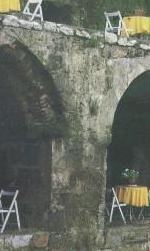
Walking west from the Ulu Mosque you arrive at Hisar,an old and picturesque quarter of Bursa. In the park that overlooks the valley are the mausoleums of Osman, the founder of the Ottoman Empire, and his son Orhan Gazi who commanded the army that conquered Bursa.The cafes of Tophane offer a good place to stop for refreshment. Nearby in Ressamlar Sokak (Artists Street) local artists work in the open air.
At the Yildiz Park Tea Gardens in the Muradiye quarter, you get a superb view of the Muradiye Complex. The compound, in a tranquil park-like setting, contains the Mosque of Sultan Murat II. (1426) built in the style of the Yesil Mosque and the tombs of Murat II, Cem and Sehzade Mustafa. These contain some of the loveliest decoration and tile work. The nearby Ottoman House Museum in a restored 17th century dwelling provides an interesting glimpse of the lives of wealthy Ottomans.
|
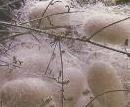
Silk Cocoons
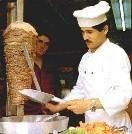
Doner Kebap
|
Tophane
Click on to image
to view details
|
Other places of interest in Bursa include the Culture Park with the Bursa Archaeological Museum and the Ataturk Museum on the road to Cekirge.
The western suburb of Cekirge has been known since Roman times for its warm, mineral-rich springs. Many modern hotels have thermal bath facilities and you can as well visit the old hamams. Yeni Kaplica (New Spring) was built by Suleyman the Magnificent's Grand Vizier, Rustem Pasa, in 1552. The Eski Kaplica (Old Spring), built on the site of the original Byzantine baths, is the oldest bath. The Karamustafa Pasa baths are reputed to have the best hot mineral waters in Bursa. Buildings of interest in Cekirge include the Mosque and Mausoleum of Murat I. and the tomb of Suleyman Celebi, a religious poet. The monument to Karagoz commemorates the character whose humorous antics are immortalized in Turkish shadow puppet theater.
|
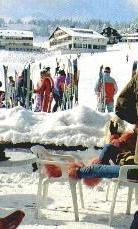
UIudag is the largest winter sports center in Turkey and offers a variety of activities, accommodation and entertainment. Thirty-six kilometers from Bursa, the slopes are easily reached by car or cable car (teleferik). December to May are the best months for skiing, although the area, which is a national park, is well worth a visit at any time of the year for the lovely views and wonderful fresh air.
A seaside resort town 25 km from Bursa, Mudanya's fine fish restaurants and nightclubs are popular with the residents of Bursa. The Armistice Museum is worth a visit. Just 12 km from Mudanya, Zeytinbagi (Tirilye) exemplifies the architecture and layout of a typical Turkish town.
The Gulf of Gemlik, 29 km from Bursa has wide sandy beaches; Armutlu and Kumla are the favorites.
|
Uludag ski center
Click on to image
to view details |

|

|
 
This site prepared by Tayfun Kalyoncu on 28.02.1997 and last updated on 01.05.1999.
For any comments and suggestion please send an e-mail using the form at page mailform.html
|